Four Steps, In Detail
What actually happens between the first phone call and the last load leaving the drive — including the parts that change a price.
What each step actually involves.
The four steps on the home page, with what happens inside each one and what you get at the end of it.
Free walkthrough
We come to the property and look at the actual ground.
Somebody walks the site with you rather than pricing it from a satellite photo. Ground conditions, access, where water goes in a storm and what is already buried are the things that move a price, and none of them are visible from a desk.
Bring the awkward questions to this visit. It is the cheapest point in the whole job to change your mind, and the only point where changing it costs nothing at all.
- No charge, and no obligation to go further
- We measure rather than pace it out
- You get told if we think you do not need the work you asked about
- If a job is not right for us, we say so at this visit rather than later
Written quote
An itemized price, in writing, that you can actually read.
The quote separates materials from labor and names what is going in - the unit, the depth, the quantity. A single number at the bottom of a page tells you nothing about whether the base under your patio is right, which is exactly where a cheap quote hides.
If you are comparing us against somebody else, compare the build-up rather than the total. Two quotes for the same patio can differ by a third and both be honest, because they are not building the same thing underneath.
- Materials, labor and quantities listed separately
- The specification is written down, not agreed verbally
- Anything excluded is stated as excluded
- The price does not change unless the work changes, and then only in writing
We build it
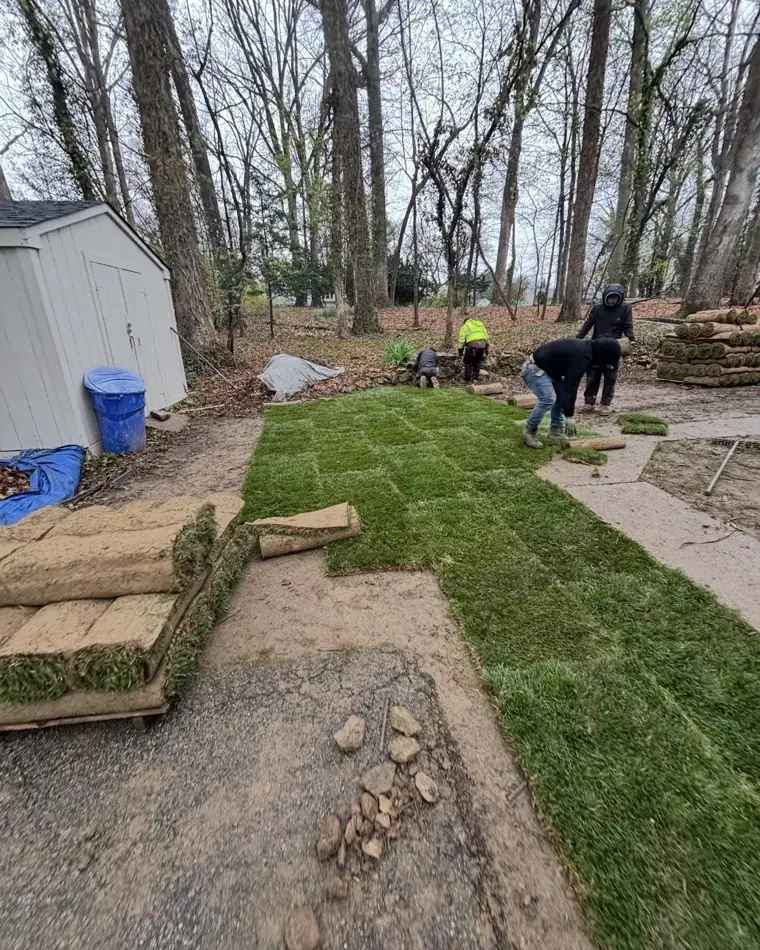
One crew, start to finish. No subcontractors.
The same people who start your job finish it. Nobody hands the site to a second firm halfway through, which is where responsibility usually goes missing and where two contractors start pointing at each other.
You will always know who is in your yard, and the person you talk to on day one is on site on the last day.
- One crew from first day to last
- No subcontracted trades brought in without telling you
- You are told when we are coming and when we are not
- Gates closed behind us, every time, without being asked
Walkthrough and cleanup
We walk it with you before we leave, and everything goes with us.
The job is not finished when the work is done, it is finished when the site is clean and you have seen it. We walk the finished work with you while the crew and the vehicles are still there, because that is when a snag takes ten minutes instead of a return visit.
Offcuts, packaging, pallets and spoil leave with us. A pile of surplus stone left "in case you want it" is a disposal problem handed to the customer.
- We walk the finished work with you on site
- Snags raised at that walkthrough get dealt with there and then where we can
- All waste, offcuts and packaging removed
- Gate closed, dog stays in
What to have ready for the walkthrough
None of this is homework. It is the handful of things only you know, and each one changes something we would otherwise have to guess at.
Where the utilities run
Anything you know about - a buried gas line, an old septic run, a dry well, an irrigation loop somebody put in years ago. We make the Miss Utility call before we dig, which is a legal requirement in Maryland and needs two full business days. It locates member utilities’ own facilities; privately owned lines run in by a previous owner are generally outside what it covers, so what you know about your own property genuinely matters.
Where the water goes now
Which corner floods, which downspout overflows, where the ground stays soft in March. You know this and we cannot see it on a dry day.
Anything under warranty or shared
A shared drive, a boundary you are not certain about, a fence that belongs to next door, a roof still in warranty. Better to know before machinery arrives.
A rough idea of what you want to spend
Not to spend it. It is so we design something buildable to that number instead of drawing you a yard you were never going to buy.
What actually changes a price mid-job
“No surprises” does not mean nothing ever changes. It means you hear about it from us, in writing, before it is built — not on the final invoice.
Something buried turns up
Old concrete, a filled-in pond, a previous patio under the lawn, rubble from a build. It happens most often on older properties and it is the single commonest reason a real job costs more than the quote.
The ground is not what the surface suggested
Made ground, running sand, or a subgrade that will not compact. It changes what has to go underneath, and it is not visible until it is open.
You change your mind
Entirely allowed, and much cheaper before the base goes in than after. Any change gets priced and agreed in writing before it is built.
Access changes
A gate that turns out to be too narrow for the machine means the material comes in by wheelbarrow instead. That is labor, and it is real.